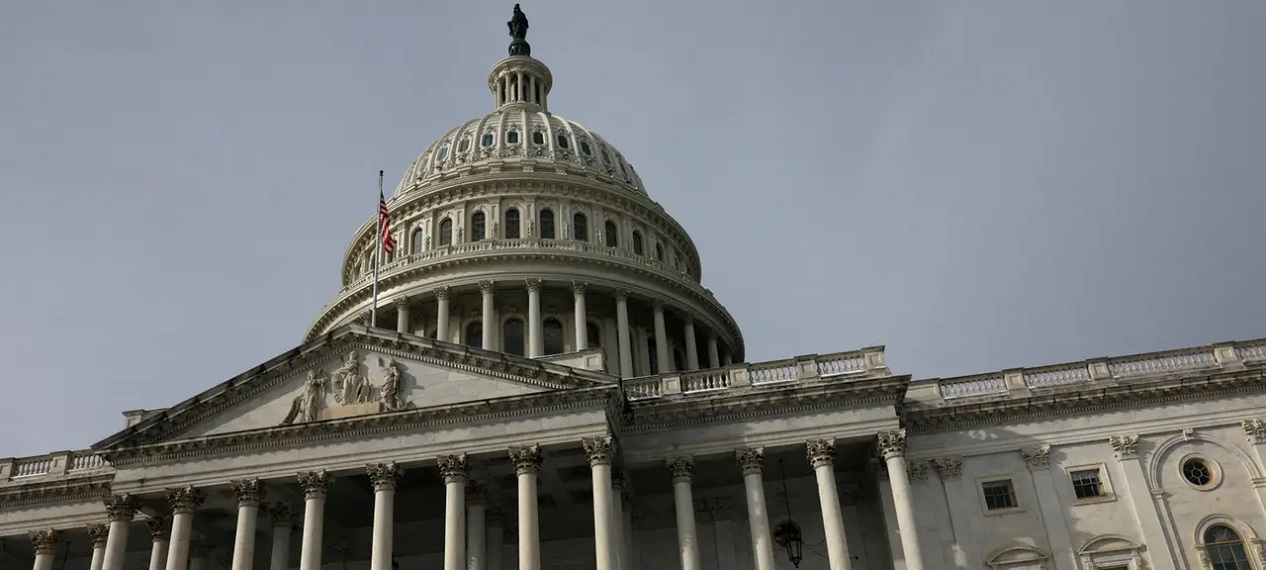
The US Congress narrowly averted a government shutdown by passing a budget package worth $1.2 trillion. Discontent already prevails among the Republicans.
In a last-minute move, the US Senate approved a trillion-dollar budget package. The vote began late Friday evening, just a minute past midnight deadline, and concluded early Saturday morning. Until the end, it remained uncertain whether there would be a partial government shutdown—a so-called “shutdown.”
Theoretically, this was briefly the case as the deadline passed before the vote concluded. However, it had no actual effect. President Joe Biden still needs to sign the law, seen as a formality. The White House announced during the night that they expected this to happen today.
On Friday afternoon, the House of Representatives approved the budget package with bipartisan support. The Senate vote delay was not due to a lack of a majority but a parliamentary tactic by Republican senators. In the end, a total of 74 senators voted for the budget package, with 24 against it.
The impact of a shutdown would have been minimal over the weekend since most affected government employees would be off duty. The situation could have become problematic if discussions had dragged on into the next week.
A shutdown means millions of government employees do not receive a salary. Many departments and agencies have contingency plans for this scenario. The extent of its impact on daily life and the US economy ultimately depends on its duration.
The newly approved $1.2 trillion budget package funds a significant portion of US government activities for the current fiscal year ending in September. It includes funds for defense, the Department of Homeland Security, and the Department of Labor, but it does not include new US financial aid for other countries like Ukraine. A corresponding legislation package is currently stuck in the House of Representatives.
The agreement on the budget package was reached between Republicans and Democrats earlier in the week after the passage of a smaller initial budget package.
Typically, Congress agrees on a large funding package to finance government operations. It should have been approved last fall. However, Republicans had opposed it, leading to a split in the budget. The second part was pending. Together, both packages now total $1.66 trillion.
The budget disputes had been ongoing for months. Meanwhile, Congress passed several continuing resolutions due to the Republicans’ blockade.
Even on this Friday, the necessary votes for the second budget package in the House of Representatives were obtained with Republican support. However, the majority of the party still voted against it. Representatives had demanded significant budget cuts, among other things.
The vote in the House could have consequences for Republican House leader Mike Johnson. Representative Marjorie Taylor Greene from the far-right wing surprisingly introduced a motion to oust her party colleague from office. Greene initially called it a “warning.” According to Greene, the budget package represents a Democratic budget she does not support. However, she also stated, “We need a new leader.”
US Economic Headwinds Intensify as New Federal Reserve Chair Focuses on Price Stability: Analyst Warns…
Exclusive: OpenAI Drops GPT-5.6 Family – Three Models, One Epic Leap in Agentic AI In…
Germany's Heat Wave: A Nation Unprepared for the New Climate Reality Berlin – In a…
The Indian Economy: Growth Giant or Fragile Superpower in the Making? India’s Economic Rise Faces…
South Africa Business News Today: Investment, Infrastructure, and Digital Innovation Shape Economic Growth July 2026…
United Kingdom Business News Today: Investment, Innovation, and Economic Resilience Drive Growth in 2026 July…