








Exclusive: OpenAI Drops GPT-5.6 Family – Three Models, One Epic Leap in Agentic AI
In a move that’s shaking up the entire AI industry, OpenAI today made GPT-5.6 — its most ambitious model series yet — generally available to the public after months of gated previews for trusted partners and U.S. government entities.
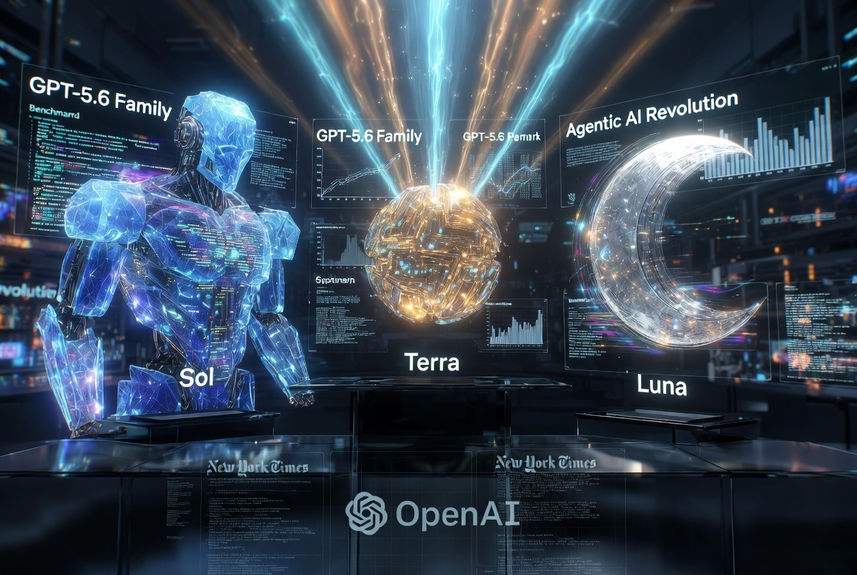
The release isn’t just another incremental upgrade. It’s three purpose-built models in one family: Sol (the heavyweight reasoning beast), Terra (balanced power), and Luna (efficient high-performer). Each is engineered for agentic workflows — the new wave of AI that doesn’t just answer questions but autonomously plans, executes multi-step tasks, and collaborates with tools or other agents.
This is the first time OpenAI has shipped a full tiered family at once, with GPT-Live voice integration already rolling out in ChatGPT Voice and a brand-new unified ChatGPT Work platform built around Codex for independent business automation.
The Numbers That Matter
- Sol targets complex coding, research, science, cybersecurity, computer use, and design. Early benchmarks show it crushing previous leaders on multi-agent coordination.
- Terra offers the best “bang for buck” for most enterprises.
- Luna is the speed demon for high-volume, lower-cost deployments.
- Pricing starts at $5/$30 per million tokens (in/out) for Sol, dropping to $2.50/$15 for Terra — still premium, but the performance jump justifies it for serious workloads.
The timing couldn’t be more telling. Just days earlier, the U.S. government lifted export controls on comparable Anthropic models, and Microsoft quietly shifted some workloads to its own in-house models to cut costs. OpenAI’s move signals it’s doubling down on frontier intelligence that scales with ambition — while the broader market watches for the next price war.
Why This Matters Right Now
Agentic AI is no longer hype. It’s the new normal. Companies that once relied on simple chatbots or single-tool scripts are now demanding agents that can:
- Manage entire workflows (email + calendar + CRM + Slack)
- Debug code across repositories
- Run simulations and iterate autonomously
OpenAI’s Codex rebrand into a “super app” with Work mode and hosted sites is the clearest sign yet that they see AI as the new operating system for business.
Meanwhile, competitors aren’t standing still:
- Meta just launched Muse Spark 1.1 — a multimodal reasoning model with a 1-million-token context window, multi-agent upgrades, and its first paid Meta Model API (priced aggressively below rivals).
- xAI’s Grok 4.5 just undercut everyone on price while claiming Opus-level performance in some areas.
- Microsoft, Google, and Anthropic are all accelerating in-house or hybrid strategies.
This isn’t a quiet week. It’s a launch week — and the models that win the next 90 days will define who owns the agentic economy.
What This Means for Developers & Enterprises
If you’re building or buying AI tools today, the rules have changed:
- Multi-model routing is now table stakes. No single model (or company) owns the crown for long. OpenRouter-style platforms are exploding for a reason.
- Agentic platforms are the new battleground. Pure chat is yesterday. Real ROI comes from agents that integrate deeply with your stack (Salesforce, Shopify, custom tools).
- Cost-per-intelligence is collapsing. Industry reports show top models dropping ~10x in effective price every year while performance rises. Early adopters who overpay today will look foolish in six months.
The Bottom Line
OpenAI’s GPT-5.6 drop is a masterclass in execution: release three differentiated models instead of one, tie them to real products (ChatGPT Work, GPT-Live), and do it at scale after government clearances. It forces every other lab to respond — fast.
For the rest of us watching from the sidelines, this is your window to evaluate, test, and build the next generation of AI-powered products. The models that emerge as “the new standard” will likely be the ones that combine frontier intelligence with rock-solid reliability, seamless integration, and enterprise-grade governance.
The agentic revolution just got a whole lot more crowded — and a whole lot more exciting.